Across every vertical studied, visitors who leave one site aren't leaving the market—they're shopping the competition. Structural pressures are squeezing the marketing funnel. Not a collapse, but a harder, more expensive, slower market that the same playbook no longer beats.
For years, the strategy for growth in the mover economy was simple: drive more traffic, capture the lead, and convert. But the rules of engagement have fundamentally changed. The "spray and pray" approach of broad PPC campaigns and generic website forms is hitting a wall of diminishing returns. To grow profitably today, brands must stop looking at the top of the funnel and start looking at the middle—the vast cohort of consumers who are actively in-market but slipping through the cracks because the channels they prefer simply aren't there.
Why the marketing funnel is under pressure
To understand why profitable growth has become so elusive, we have to look at the macroeconomic forces at play. The market isn't shrinking in terms of intent; it is shrinking in terms of affordability and confidence. Fewer people are moving, those who are moving are facing higher financial barriers, and the cost to acquire them is skyrocketing due to digital saturation.
When you combine a smaller total addressable market with a buyer who is financially stretched, you get a consumer who takes significantly longer to make a decision. They are doing more research, comparing more options, and delaying the final commitment. This behavior creates a compounding effect on your marketing metrics.
Negative macro conditions don't hit one funnel metric—they compound across all three, quietly undermining profitable growth. Small declines across CPC, Conversion Rate, and Lead-to-Customer ratios don't add. They multiply. If your cost per click goes up 15%, your conversion drops 13%, and your close rate drops 10%, you haven't lost 38% of your efficiency—you have effectively cut your ROI in half. Same spend, CAC up ~48%.
| Variable | Growth Zone | Compounded Decline | Variance |
|---|---|---|---|
| PPC Investment | £100K | £100K | Same (£100K) |
| Cost per Click (CPC) | £3.00 | £3.45 | 15% |
| Website Conversion Rate | 3.50% | 3.04% | -13.2% |
| Leads | 1,167 | 881 | -25% |
| Customer Acquisition Cost | £571 | £844 | +48% |
A 15% increase in CPC and a 13% drop in conversion doesn't just add pressure—it compounds it, driving CAC up by nearly half.
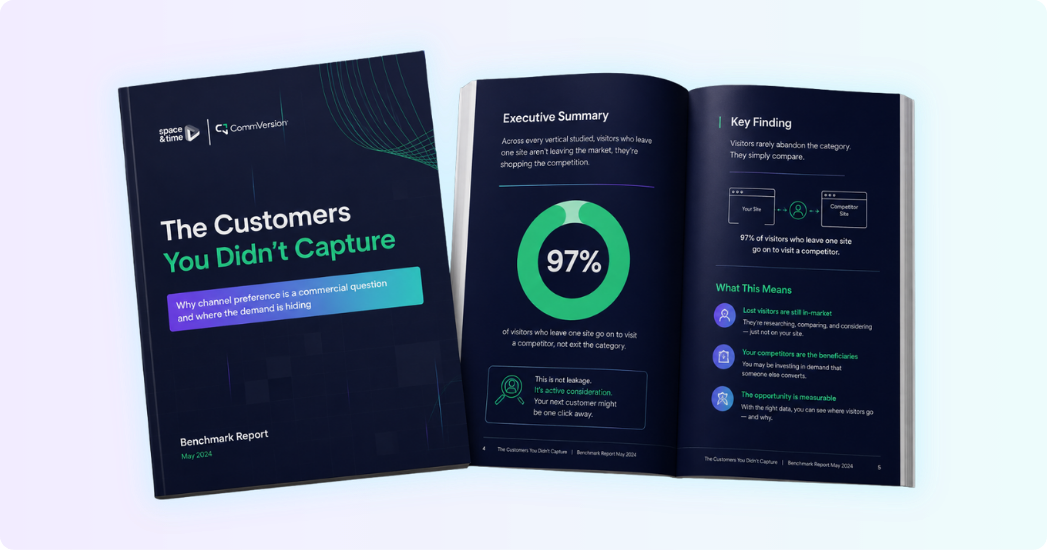
97% of visitors leave without converting.
And they aren't leaving the market—they're shopping your competition.
Source: Industry Cross-browsing Analysis, 2026
This is the core challenge—and the core opportunity. If 97% of your traffic is leaving your site, you are likely treating that as a loss. But the data shows that these visitors aren't abandoning their intention to buy. They are simply engaging with a competitor who offers a frictionless path to inquiry. The question is: Are you providing that path?
Where the demand is hiding
High intent. Motivated to enquire any way they can. Your enquiry data is full of this cohort, but they were never the contest. Winning more of them isn't where marginal growth is.
The growth is the cohort behind your existing buyers. We call them "The Defectors" and "The In-Market Researchers." These are consumers who are actively in the market—they have a need, a timeline, and a budget—but they are not contacting you. Why? Because the channel you offered didn't match the channel they wanted to use.
Because they're channel-sensitive, the channels you offer decide whether you capture them. If you only offer a generic web form and a phone number, you are actively filtering out hundreds of thousands of high-intent buyers who prefer WhatsApp, Live Chat, or SMS.
What 2,002 UK Adults said: Channel Preference
To validate this theory, we surveyed 2,002 UK adults to understand exactly how they want to communicate during a high-value purchase journey. The results were illuminating. While traditional channels like phone, forms, and face-to-face interaction still lead overall, live messaging channels register 8-13% preference throughout the journey.
Channel Preference by Journey Stage (%)
However, when we break this data down by age, a clear generational shift emerges. For the prime mover demographic (25-44), messaging demand doubles. This isn't a Gen-Z trend; it is a life-stage signal. Young families and first-time buyers are busy, digitally native, and expect instant, asynchronous communication as the default.
The Human vs. AI Trust Barrier
Now, here is the crucial nuance. At the contact handover, AI hits a trust barrier that humans and traditional forms don't. The data clearly shows that customers are not afraid of digital channels. They are, however, highly suspicious of automated AI when it comes to giving up their personal data for a high-value purchase.
Comfort level sharing contact details
Swapping a human for AI on the same channel drops comfort 28 points (66% to 38%). It's not digital that's the problem—it's AI specifically.
This is a critical strategic insight. You cannot simply throw a chatbot on your site and call it omnichannel. To win the Defector and Researcher cohorts, you must offer the right channel (messaging) with the right human touch. The "human handover" remains the most trust-building moment in the customer journey.
4 Things that are true at once
As you digest this data, it is essential to recognize that these four truths exist simultaneously. They are not mutually exclusive. To grow in 2026 and beyond, your strategy must account for all of them:
The macro compounds against you
Negative macro conditions don't hit one funnel metric—they compound across all three, quietly undermining profitable growth. A multi-channel approach is the only way to counteract this friction.
The opportunity is the cohort behind your buyers
The in-market cohort still researching is a material, under-captured source of growth. A small lift drives a significant marginal gain—often the difference between a flat year and a profitable one.
Winning them depends on channel
That cohort is channel-sensitive. Capturing them means provisioning the channels they prefer—traditional and messaging—not just the ones your current buyers use. If you aren't on their preferred channel, you don't exist to them.
The human still matters at the handover
At the moment the lead is won, AI hits a trust barrier humans don't. Be available on the right channels, but keep a person where it counts. Technology facilitates the connection; humanity closes the deal.
The takeaway is clear. The market has changed. The buyers have changed. And the channels they use to engage have changed. The brands that will win in the coming years are not the ones with the biggest budgets, but the ones that offer the right channels, with the right human touch, at the right time.
See how many Defectors and Researchers your own site is losing.
Talk to an Expert.png)
.png)
.png)

.png)
.jpg)