A buyer fills in an inquiry form on a builder's website. They have usually compared several communities, and may be contacting more than one builder. How quickly each builder responds can decide who gets the first conversation.
An annual mystery shop of US homebuilders measures exactly this. It sends inquiries to builders, then tracks every response for 30 days. The 2025 edition, released in January 2026, gives a useful picture of how builders handle online leads today.
What the 2025 study found
The study was run by Blue Gypsy, Denim Marketing and Melinda Brody & Company. It covered 50 builders, from national production builders to small local ones. Mystery shoppers submitted inquiries during regular business hours and scored the responses on speed, personalization and persistence.
The main results:
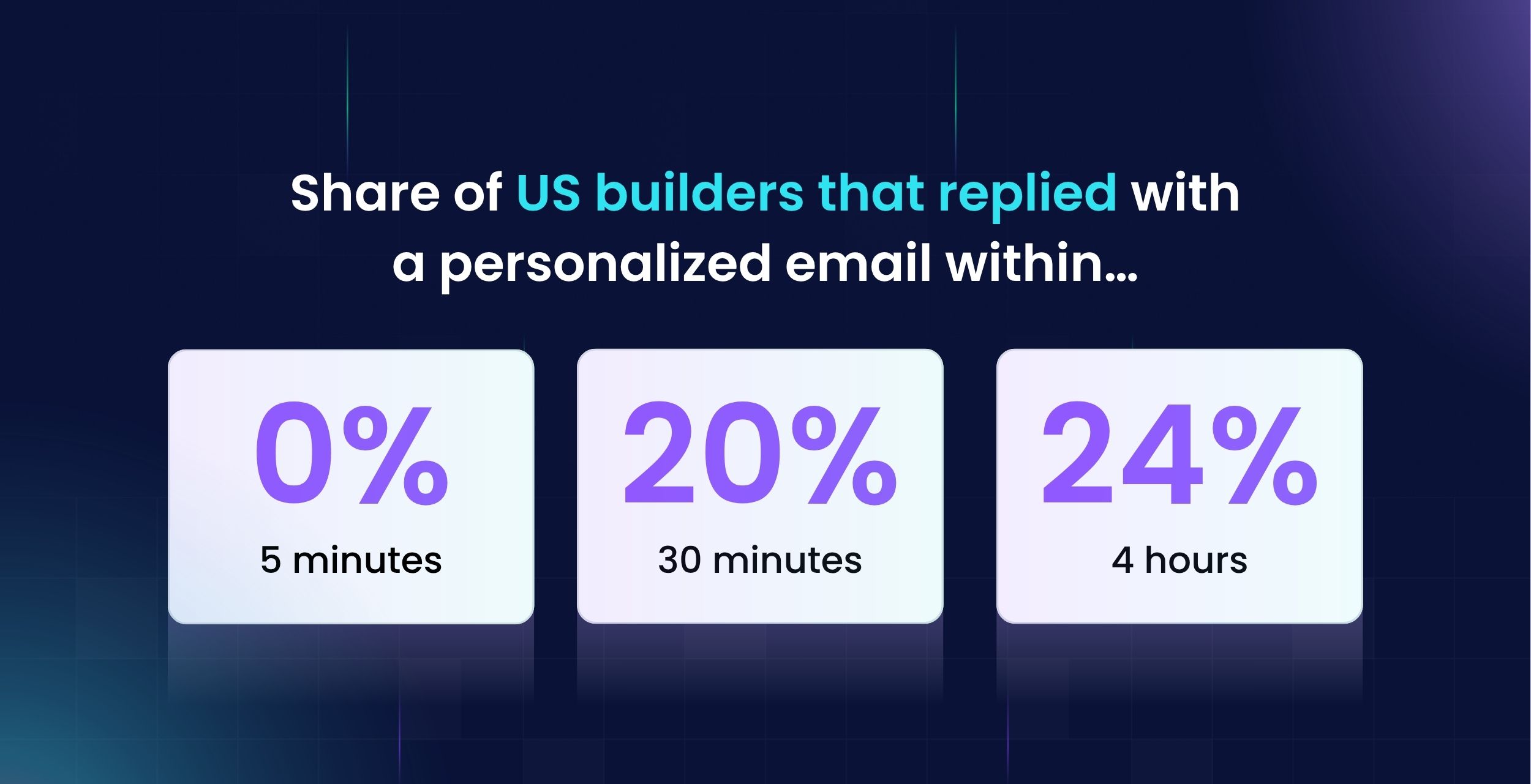
- No builder sent a personalized email within five minutes. Five minutes is the response time most often cited as the target.
- 20% responded within 30 minutes, and 24% within four hours.
- 22% never sent a personalized email at all.
- 58% of builders made a phone call, down 8 points from the previous year.
- 62% sent a text message and 34% sent a video email. Both figures were up 12 points.
- 66% reached five or more personalized touchpoints across at least two channels.
Builders have improved on some measures. Earlier surveys by Do You Convert, which has tracked builder follow-up since 2012, found 70% of builders not calling and 38% not answering an emailed inquiry in 2020, with the first email taking an average of 2.3 days. Text and video follow-up have grown since then. Speed is the weak point: in 2025, fewer than a quarter of builders had replied within four hours, and none had sent a personalized email within five minutes.
The gap comes down to who owns the lead
The clearest finding in the 2025 data is the difference between builders with a dedicated online sales counselor and those without one.
- 73% of builders without an online sales counselor never sent a personalized email. Among builders with one, the figure was 3%.
- About 90% of builders with a counselor made at least one phone call. Among those without, it was 10%.
- Every call made within five minutes came from a builder with a counselor.
- The 2024 edition found that 75% of builders without a counselor took more than three days to call.
Where one person is responsible for online inquiries, they get answered. Where the inquiry goes to a general inbox or a community sales agent already busy with visitors on site, it often waits. That is a staffing and ownership problem more than a technology one.
It is also worth noting that the share of builders using online sales counselors fell from 78% in 2024 to 70% in 2025. Rising costs may explain part of that, but the study does not say.
What the studies do not measure
The data has two limits that matter for any builder reading it.
First, every inquiry in the 2025 study was submitted during regular business hours. The study says nothing about inquiries that arrive in the evening or at weekends, which is when many buyers research. A builder that responds well at 10am may have no response at all at 9pm.
Second, none of these studies link response speed to closed sales. They show how builders behave. They do not show how much revenue is lost. Claims that a given response time doubles conversion usually come from vendors and should be treated with caution unless the source and sample are named.
What builders can do
A few practical steps follow from the research, and none requires new software.
- Decide who owns online inquiries. The strongest predictor of good follow-up in the data is having a named person or team responsible. If inquiries currently go to community sales agents alongside everything else, check how long they wait.
- Set a response standard and measure it. Many builders do not know their own average first response time. Pull the timestamps from the CRM for the last 30 days, split by time of day and day of week, and compare against a target such as five minutes during business hours.
- Make the first reply specific. In earlier studies, many first responses were generic brochures that ignored what the buyer asked. Referencing the community, the plan or the question the buyer submitted takes little time and separates the reply from an automated message.
- Use more than one channel. The builders in the 2025 study that reached five or more touchpoints did so across at least two channels, usually email plus phone or text.
- Decide what happens outside business hours. Automated acknowledgments help, but a buyer asking about a specific plan or financing option will want an answer. Builders should decide who handles evening and weekend inquiries, and how quickly the next morning's follow-up happens.
- Test your own process. The simplest audit is to submit an inquiry to your own website at 9pm on a weeknight and another on a Saturday morning, and record what comes back and when. Do the same for two or three competitors. The results are usually more convincing to leadership than any industry benchmark.
The takeaway
Builders are putting more effort into follow-up than a few years ago, but first response is still slow, and the evidence for evenings and weekends is missing. The builders with the best results in the data are the ones with clear ownership of online inquiries. For most teams, the useful first step is to measure their own response times before deciding what to change.