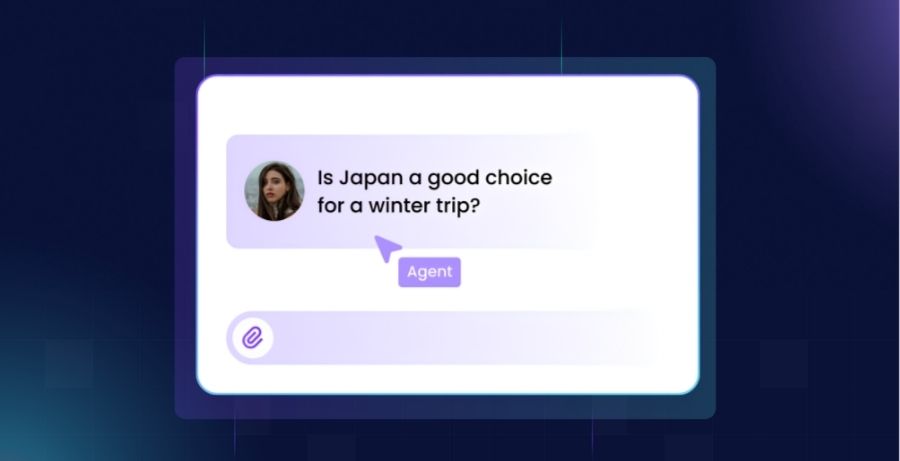
Someone booking a two-week trip rarely does it in one sitting. They open a handful of tabs, compare a few itineraries, close the laptop, come back two days later with new questions, and eventually book with whichever business answered them fastest and felt most trustworthy along the way. Live chat exists to be that business. Most travel websites have some version of it. The data suggests very few use it well.
What is live chat
Strip away the branding and live chat is a real-time conversation sitting on a website. Instead of a visitor filling in a form and waiting for a reply, they ask a question and get an answer while they're still deciding. That's the whole idea. Everything else, chatbots, AI, targeting rules, is really just different ways of deciding who gets a conversation, and who's having it with them.
Reactive chat versus chat that works
Most live chat is reactive. A small bubble sits in the corner of the screen, and it only does anything once a visitor notices it and clicks first. For someone who's still comparing options and hasn't committed to anything, that bubble often never gets clicked. They leave with their questions unanswered, and the business never even finds out they were there.
The better version is proactive. It reads behaviour, how long someone's spent on a page, whether they've scrolled through the same itinerary twice, whether they're hovering near the exit, and starts the conversation itself, before the visitor decides to leave. That one difference, reactive versus proactive, explains most of the gap between chat that quietly sits there and chat that actually converts.
The second difference is who's on the other end of it. A chatbot can answer "what's your cancellation policy" well enough. It gets shakier on "we're a family of five with two kids under ten, is week three of this itinerary too ambitious for us." Travel questions are rarely simple lookups. They're judgement calls, and judgement calls need someone who can actually reason about the answer, not just retrieve one.
What the conversion data shows
The industry-standard figure, cited across most 2026 benchmarking reports, is that visitors who use live chat convert at roughly 2.8 times the rate of visitors who don't, a figure reported independently by both Ringly's 2026 live chat statistics roundup and GreetNow's quarterly-updated benchmark data, which is worth treating as a reasonable baseline rather than a marketing claim from a single vendor.
Travel skews even higher than that average. Which 50's 2026 breakdown of chat-to-conversion rates by industry found automotive, real estate and travel sitting among the highest-converting categories overall, with chat lifting conversion by roughly 25 to 40 percent specifically on travel sites, and itinerary-building conversations converting close to twice as well as the equivalent static web form. That tracks with what the sector's nature would predict: a form can't answer "does this actually suit us," a person can.
None of this means every chat interaction is worth the same. A visitor asking a one-line factual question converts differently to one who's spent ten minutes comparing two itineraries and has a specific concern. The averages above describe what's possible when chat reaches the right conversation, not a guarantee for every click of the bubble.
The moments that matter
Not every visitor needs the same thing from chat. Early in someone's research, most questions are broad: what's included, roughly what this costs, whether it's the right type of trip at all. A quick, accurate answer here is often enough to keep them reading rather than opening a competitor's tab instead.
Later, once they've narrowed it down to one or two options, the questions get sharper and more specific to their own circumstances: room configurations, dietary requirements, whether a particular excursion suits a nervous flyer or a toddler. This is the stage where a real person earns their place, because a generic answer here reads as generic, and a considered buyer notices the difference. One US-based cabin rental business, cited in LiveChat's own travel and tourism case studies, credited canned but genuinely useful chat responses to frequent questions with directly increasing their booking sales.
Then there's the moment right before booking, often the highest-value one of all. Someone's filled in most of a form, or sat with a cart open, then paused. That pause is rarely indecision about the trip itself. More often it's one unanswered question standing between them and paying. Catching that moment, rather than letting the tab quietly close, is usually worth more than every other chat interaction on the site combined.
How travellers use chat
Preference data backs up the shift toward chat as a default, not an alternative. Around 41% of consumers now name live chat as their preferred customer service channel, ahead of both phone and email, and the gap widens further with younger travellers: roughly 56% of 18 to 34 year olds say they'd choose chat over a phone call given the option, according to GreetNow's and Ringly's respective 2026 data.
Expectations around speed have also moved. Current benchmarking puts the figure at 71% of consumers now expecting a first response inside 60 seconds, a bar that's risen sharply as chat has become the norm rather than the exception. Mobile matters here too, a large share of travel research and browsing now happens on a phone rather than a desktop, which is part of why chat, something that works naturally on a small screen, has overtaken email for a lot of pre-booking questions.
There's also a forward-looking shift worth noting. A recent Statista-backed survey found that roughly 80% of travellers globally now say they're open to using AI to help plan, book, or manage a trip, suggesting the discomfort some businesses assume customers feel toward AI-assisted conversations is smaller than it used to be, provided the AI is genuinely useful rather than a barrier between the visitor and a real answer.
What this doesn't mean
None of this means chat needs a person glued to it around the clock. A small travel business can't realistically staff live chat at two in the morning, and it shouldn't try to. The actual point of proactive targeting is working out which moments are worth a human response and which aren't, so whatever coverage exists gets used where it changes an outcome, rather than being spread thin and even across every hour of the day.
Where adoption is heading
This isn't a static picture. Gartner's own research, based on a 2025 survey of 265 customer service leaders, projects that live chat and self-service will overtake phone and email as the primary customer service channels by 2027, a genuine shift in how the average customer expects to reach a business at all.
The market data points the same direction, though the exact scale depends on who's measuring it. One 2026 market analysis puts the global live chat software market at roughly $1.14 billion in 2025, rising toward $2.43 billion by 2035, while a separate report puts current market size closer to $790 million, heading toward around $1.3 billion over a similar window. The two disagree on scale, which is fairly normal for software market sizing across different research methodologies, but they agree on direction: the market is on track to roughly double over the next decade, not shrink or plateau, and both single out travel and hospitality as one of the categories driving that growth, alongside other high-consideration purchases where a visitor's questions are too specific for a static page to answer alone.
Where AI helps, and where it doesn't
The rising openness to AI, that 80% figure among travellers cited earlier, is easy to misread as permission to remove the human element from the conversation entirely. The more accurate reading is narrower. Travellers are increasingly comfortable with AI handling the parts of a conversation that don't need judgement, surfacing availability, pulling up a relevant itinerary, answering a factual question instantly, provided a person is still there for the parts that do.
That distinction matters more in travel than in most sectors, because so many travel questions sit exactly on that line. "What's the cancellation policy" is a lookup, and AI handles it well. "Is this itinerary too much for my elderly parents" isn't a lookup, and a chatbot that answers it as though it were tends to lose trust rather than build it. The businesses getting the most out of AI in chat generally aren't using it to replace the conversation. They're using it to make sure the person having that conversation has the right information in front of them before they reply.
Factual lookups, availability, pricing, cancellation policy, quick reference questions where the answer is straightforward and doesn't require judgement.
Judgement calls, suitability questions, itinerary fit for specific circumstances, complex multi-part questions that require reasoning rather than retrieval.
What good looks like in practice
This is roughly the shape CommVersion's SmartChat takes. SmartTargeting reads visitor behaviour and identifies the moment someone's about to leave without booking, a trained specialist takes the conversation from there, and AI Assist feeds that person the right information in real time so the answer is fast and still genuinely useful. The AI isn't the one talking. It's making sure the person who is has what they need, when they need it.
None of this is complicated. It's proactive rather than reactive, and it's a person rather than a script, at the exact moment someone's deciding whether to book or quietly close the tab. Getting that one moment right tends to matter more than any amount of polish on the rest of the site.
See what your website traffic is worth
Most travel sites have chat. Very few use it well enough to move the needle on bookings. CommVersion will show you the uplift on your own traffic before you commit to anything.
.png)
.png)
.png)

.png)
.jpg)