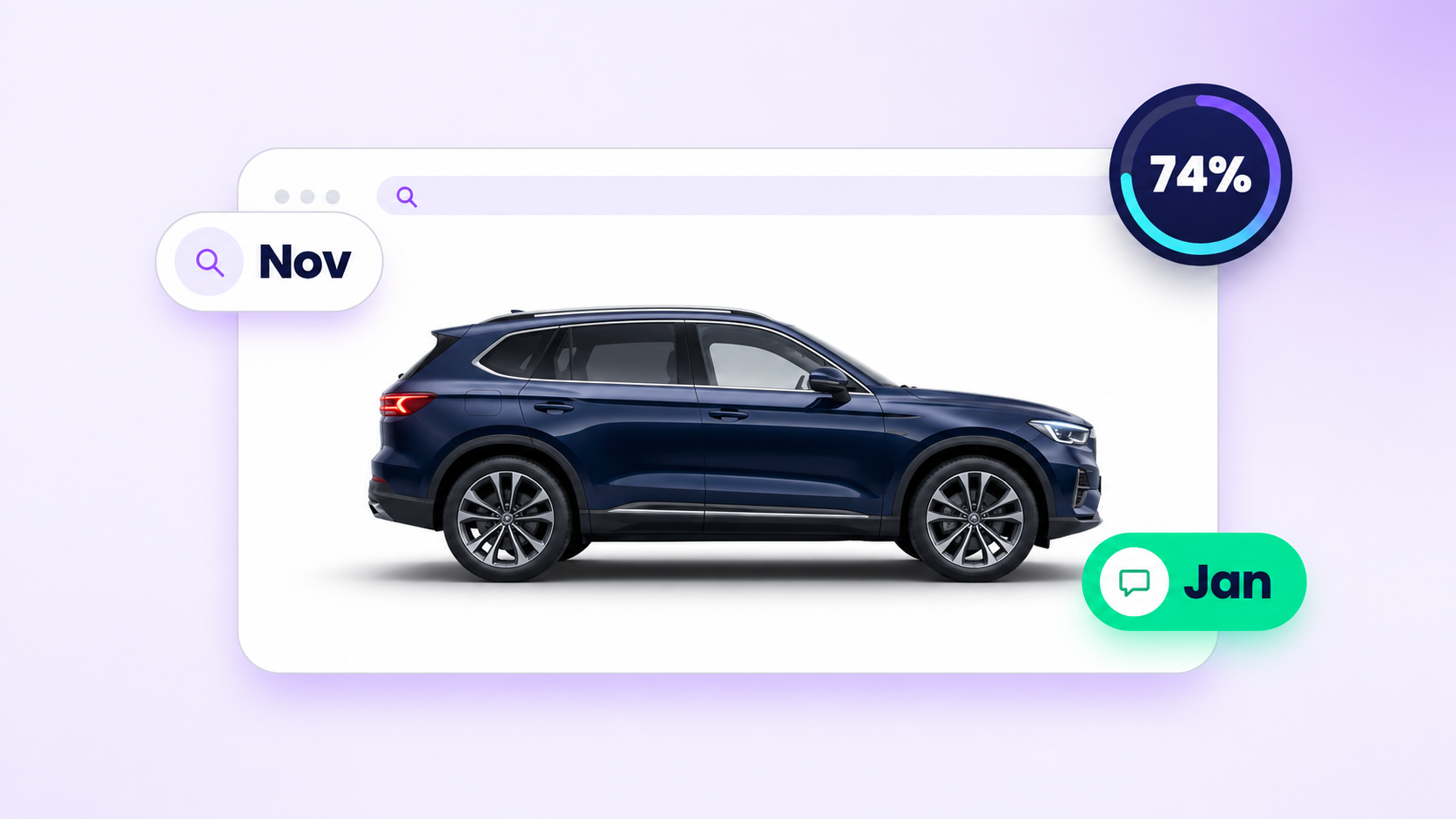
Many dealers plan for January as the month buyers appear. The buyer sees it differently. In research published in December 2024, Auto Trader reported that 74% of January buyers start browsing in November and December, and that the average research period is 87 days. By the time an enquiry reaches you, most of the comparing has been done.
Source: Auto Trader, December 2024.
That changes what November and December are for. They are not the quiet weeks before the busy period. They are the weeks when your website is being compared with others, and when buyers form the shortlist that your enquiries will later come from.
Why this matters before January
Car buying is a long process, and the dealer joins it late. Buyers research for weeks, compare several vehicles and retailers, and contact a dealer near the end. You cannot see any of this. Your first sign of a buyer is the enquiry, or a visit to your website that ends without one.
For a January buyer, the website visit that counts may happen in November. The enquiry you receive, or do not receive, depends on whether that visitor could get an answer when they had a question.
Where dealers lose these buyers
A buyer who is shortlisting in November will have questions. Is the car still available? Can the price be confirmed? What would the monthly cost be with a part-exchange? Does the car have the specification listed? If nobody can answer when the buyer asks, they do not wait. They move to the next retailer on their shortlist.
CommVersion tested this directly. In The Automotive Response Gap, we mystery shopped 33 UK dealer and leasing broker websites across three test windows in a working week. Twenty-three offered no visible way to get a real-time response at any point. Ten had chat, and only five of the 33 showed human or hybrid agent capability. The average benchmark score was 10.0 out of 45.
33 UK dealer and leasing broker websites. Source: CommVersion, The Automotive Response Gap.
The benchmark measures how sites respond, not sales outcomes. What it shows is how many sites have nothing in place when a buyer asks a question.
What to have in place before browsing peaks
1. Listings that answer the obvious questions.
Check price, photos, mileage, specification and finance information on every vehicle, and remove anything sold. A buyer comparing five cars will drop the one with missing or inconsistent details before they ever think of contacting you.
2. A real-time way to respond.
A form or a phone number is not the same thing. The buyer needs a way to ask a question and get an answer while they are on the page. If your showroom is closed in the evening or over the Christmas period, decide who covers those hours, or use a managed service that does.
3. A conversation that creates a next step.
An answer alone does not produce a lead. The strongest sites in our study took contact details, offered a callback or a transfer to a person, or set up a clear next step before the buyer left. Check what your chat or enquiry process actually does when a buyer shows interest.
4. A clear handover to your sales team.
Decide what the team receives (contact details, the vehicle, the question asked) and how quickly they must respond on the next working day. Over Christmas and New Year, confirm who is picking up enquiries on each trading day.
5. A holiday plan that someone owns.
Opening hours, bank holidays and staff leave change in the same weeks that browsing is rising. Write the cover plan down and name the person responsible for it.
Test it before the buyer does
The simplest check is to behave like a buyer. In the next two weeks, visit your own website in the evening and again at a weekend. Ask a real question about a car in stock. Note whether anyone can respond, how long it takes, and whether the conversation leads to a next step. Repeat the test on your two closest competitors.
If nobody responds, or the conversation ends without a next step, you have found the gap while there is still time to fix it.