.jpg)
Nobody reserves a plot after one visit to a developer's website. They'll look at the floorplans more than once, check the specification list against a competing development three miles away, search the builder's name alongside "reviews" or "problems," and work out roughly what they can afford before they ever pick up the phone. Most will drive past the site, too. By the time someone's ready to ask a question, they've usually already ruled out two or three other developments without telling anyone.
This guide covers what live chat is, the state of adoption and where it's heading, how UK housebuilders are already using it, what it does for website conversion, the different types available, and the honest pros and cons, including specific examples, Cala Homes and Crest Nicholson among them, of who's running it today.
What live chat is
Live chat is a real-time messaging channel on a website that lets a visitor ask a question and get an answer immediately, while they're still deciding, rather than after. A form only captures someone once they've already decided to enquire; chat can reach them earlier than that.
On a housebuilder's website specifically, that usually means a small window a visitor can open from any page, a plot listing, a floorplan, a specification document, to ask something directly rather than searching the site for an answer or picking up the phone.
The state of live chat in property, and where it's heading
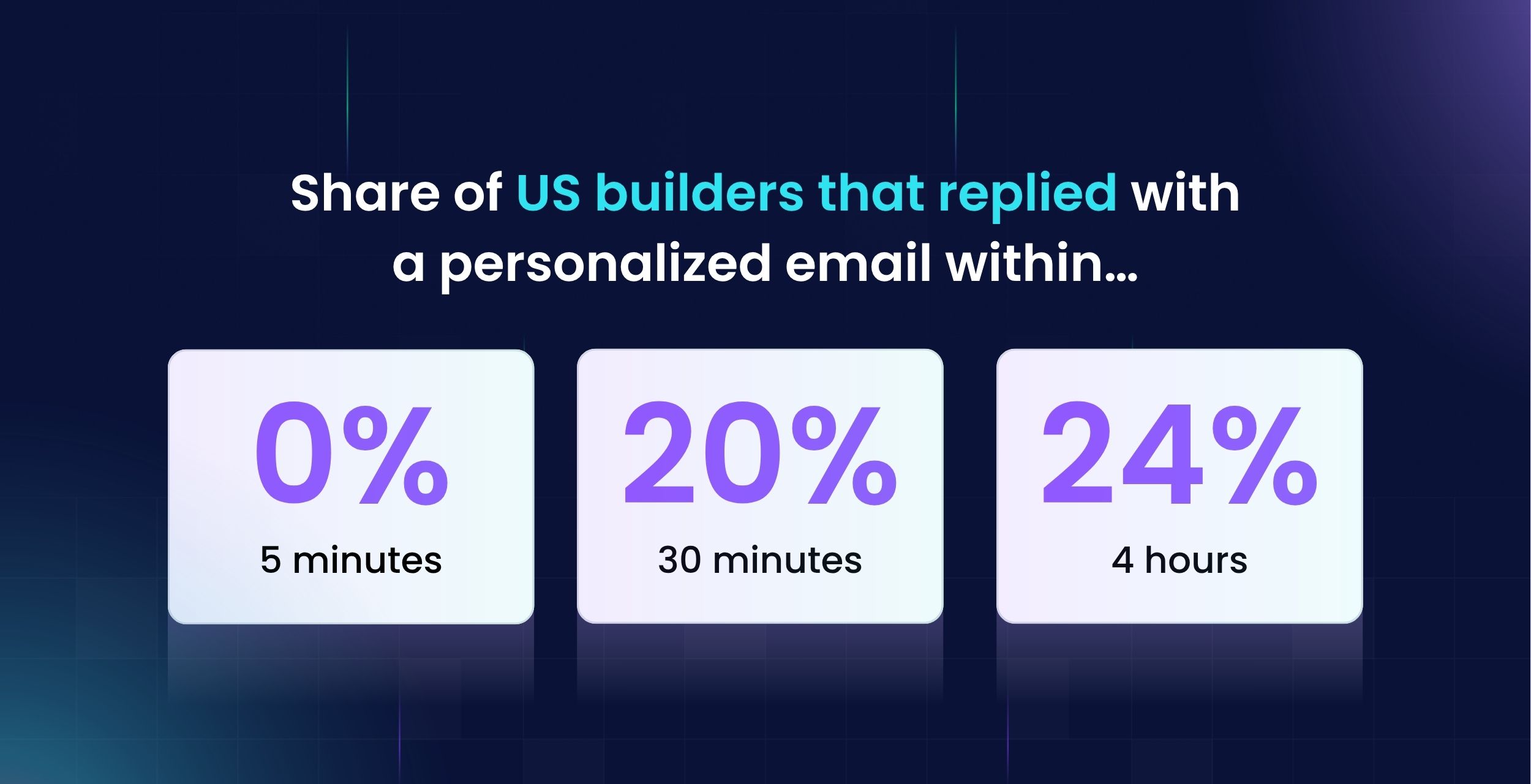
Real estate has the highest chatbot and live chat adoption of any sector tracked, at roughly 28% of sites, according to a 2026 analysis of real estate lead response data. The same analysis found that agents and developers who respond to an enquiry within five minutes are 21 times more likely to qualify that lead than those who don't, while the average response time across the sector still sits above 15 hours.
That adoption is still rising. Gartner's own research, based on a 2025 survey of 265 customer service leaders, projects that live chat and self-service will overtake phone and email as the primary customer service channels by 2027, across sectors generally, not property specifically. Property is simply one of the sectors furthest along that curve already.
How UK housebuilders are already using it
This isn't a hypothetical trend. In June 2026, Zoopla announced that Crest Nicholson, Cala and Allison Homes had all signed up to its enhanced new-homes product specifically to drive more reservations, and Zoopla's own housebuilder research reports a 30% year-on-year uplift in quality leads for developers who've increased their investment in this part of the funnel.
In practice, that investment shows up at different points in a buyer's search. Early on, most questions are broad: price range, what's included as standard, distance to the nearest station. Once a visitor has narrowed things down to one or two plots, questions get more specific: whether a particular plot's garden faces the right way, what the actual completion date looks like versus the marketing brochure's estimate, whether part-exchange or a specific mortgage scheme applies to their situation. Generic answers don't work at that stage: these are questions about a specific plot, a specific buyer's finances, and a specific timeline, not something a static page can handle.
The highest-stakes point is the moment right before someone reserves. A reservation fee is a real commitment on a purchase most people make only a handful of times in their life, and hesitation at that point is rarely about the house. It's usually one unresolved question, often financial, left unanswered while the buyer decides to wait. That's the gap between a reservation and a lead the developer never hears from again.
86% of UK property search traffic runs through Rightmove alone, with Zoopla accounting for most of the remainder. A portal listing is where a buyer discovers a development, not where a reservation happens. What happens once they click through to the builder's own site is a separate problem, and it's one a lot of housebuilder websites still haven't solved.
How live chat helps convert more website traffic
Real estate converts differently to almost every other sector: it's a long, considered purchase, not an impulse one. Ruler Analytics' 2026 benchmark, built from over 110 million tracked sessions and £33.8 million in tracked marketing spend across 13 industries, puts the real estate sector's overall conversion rate at 2.5%, sitting at the lower end of their benchmarks alongside travel, not because the marketing underperforms, but because the buyer's journey involves more research and more touchpoints before anything is captured as a conversion at all.
Lead-to-close figures tell a similar story from a different angle. One 2026 industry analysis puts the average online lead conversion rate at 0.4% to 1.2% across all sources, roughly one to two closings per 200 leads, with top-performing teams reaching 3% to 5% and the strongest platforms hitting 7% to 9%. The gap between average and elite isn't really about marketing spend. It's about speed and follow-up.
CommVersion's own work with Cala Homes recorded a 36% uplift in website conversion, without any increase in advertising spend, after replacing a standard contact form with a proactively targeted, human-staffed chat system.
The different types of live chat
Not all live chat works the same way, and the differences matter more than the label.
Rule-based chatbots follow a fixed script: a visitor picks from preset options, and the bot routes them accordingly. They're cheap to run and fine for simple, repeatable questions, but they break down fast against anything specific to a buyer's own situation.
AI chatbots go further, generating open-ended responses from a knowledge base rather than a fixed script. They handle a wider range of questions than a rule-based bot, but they're still answering, not reasoning, and a question that depends on a buyer's actual circumstances, family size, timeline, finances, can get a confident-sounding answer that's wrong.
Human-staffed live chat puts a real person on the other end of every conversation. It handles judgement calls properly, but it's only as good as the person answering and the hours they're available, and it costs more to run at scale.
Hybrid systems combine the two: AI handles retrieval and drafting in the background, a person has the actual conversation. This is also where the reactive-versus-proactive distinction matters most. A reactive system, of any type, waits for a visitor to click first. A proactive one notices behaviour, dwelling on a plot page, reopening the same specification PDF, returning to the site a third time that week, and starts the conversation itself. Buyers still comparing developments rarely click a passive widget; a system that notices them first catches conversations a passive one never has the chance to.
Buyers are generally comfortable with AI handling the parts of a conversation that don't require judgement: confirming a price range, listing what's included as standard, checking whether a plot is still available. Where it gets shakier is anything that depends on someone's actual circumstances: "would this plot suit a family with a dog and a home office" isn't a lookup, and neither is "we're relying on the sale of our current home completing by March, is that realistic for this development's timeline." A chatbot that answers those as though they were simple questions tends to lose the trust it needed to earn a reservation.
Price ranges, standard inclusions, plot availability, factual lookups, quick reference questions where the answer is straightforward.
Judgement calls about specific buyer circumstances, timeline feasibility, plot suitability for individual needs, complex multi-part questions.
A few providers active in this space: CommVersion combines proactive AI targeting with human-staffed conversations, built specifically for considered purchases like new-build property. HubSpot bundles live chat into its wider CRM, which suits teams already running marketing and sales through HubSpot (see our full comparison for what that trade-off actually involves). Drift built its reputation on AI-first chat for enterprise B2B sales, though its owner announced a sunset of the product in 2026, worth knowing if it's still on a shortlist (see our comparison for what that means in practice). Intercom focuses on customer messaging across the whole post-sale relationship rather than just the pre-sale enquiry. LiveChat is a widely used generalist platform, straightforward live chat without a property-specific or CRM-specific angle.
Pros and cons
Pros:
- Reaches buyers during the research phase, not just at the point they've already decided to enquire, which is where most of the buyer journey actually happens.
- Matches how buyers already say they want to be reached: real estate has the highest chat adoption of any sector, and response speed correlates directly with lead quality (21 times more likely to qualify within five minutes, per the data above).
- Genuine conversion upside where it's implemented well, the gap between an average and an elite lead-to-close rate is roughly 6 to 8 percentage points, and speed and follow-up explain most of it.
- Doesn't require round-the-clock staffing to be effective. Enquiries cluster into evenings and weekends, so a system built to prioritise the right visits can run on far less coverage than "always on" implies.
Cons:
- Ongoing cost, whether that's a subscription, a staffing commitment, or both, and it scales with volume rather than being a one-off spend.
- A poorly implemented version, a passive widget nobody staffs, or an AI-only bot answering questions it shouldn't, can do more harm than having no chat at all, since a bad experience is worse than no experience.
- It doesn't fix an underlying problem elsewhere in the funnel. If a development's pricing, location, or specification isn't right for the traffic reaching the site, chat won't change that.
- Requires genuine buy-in from a sales team to work well. A system that generates a qualified conversation still needs someone to follow it through to a reservation.
Common misconceptions
"Live chat takes enquiries away from phone and forms." In most implementations it's the opposite. Proactive targeting reaches visitors who were about to leave without enquiring through any channel, not visitors who were already going to call or fill in a form. Done well, it adds a channel rather than competing with the ones already working.
"It's only worth it for big developers with big budgets." Cost generally scales with how it's used. A developer running proactive targeting on a handful of active plots isn't paying for the same coverage as a national housebuilder running dozens of developments at once.
"Chat leads are lower quality than a phone call or a form." The data points the other way. Response speed correlates directly with lead quality, not the channel itself, and chat is usually the fastest channel to respond in when it's staffed properly.
Frequently asked questions
Does live chat replace phone enquiries? No, and it isn't meant to. A well-targeted system reaches visitors who weren't going to call or fill in a form at all, catching interest that would otherwise be lost rather than diverting enquiries away from other channels.
How much does live chat cost for a housebuilder? It varies by provider and model. Some charge a flat subscription per seat, others price per lead or per resolved conversation. There's rarely a single market rate, worth getting a quote based on actual site traffic rather than a generic estimate.
Do we need to staff it ourselves? Depends on the provider. Some platforms are self-staffed, your own team answers, others are fully managed with specialists included as part of the service. Neither approach is wrong, it depends on whether a developer already has spare sales capacity to dedicate to it.
Will live chat work with our existing CRM or sales process? Most established providers integrate with common CRM and property management systems, but it's worth checking specifically, since integration depth varies significantly between providers.
Is live chat data handled properly under UK GDPR? It should be, but this depends on the provider rather than being guaranteed by the channel itself. Worth confirming where conversation data is stored, how long it's retained, and whether the provider is UK/EU GDPR compliant before signing up.
What this requires
None of this depends on any one developer's brand, pricing, or product mix. It comes down to two things: a system that notices a buyer before they leave rather than waiting to be clicked on, and a person, not a script, who answers once it actually matters.
See what your website traffic is worth
Most housebuilder websites have chat. Very few use it well enough to move the needle on reservations. CommVersion will show you the uplift on your own traffic before you commit to anything.
Book a Demo →.png)
.png)
.png)

.png)
.jpg)